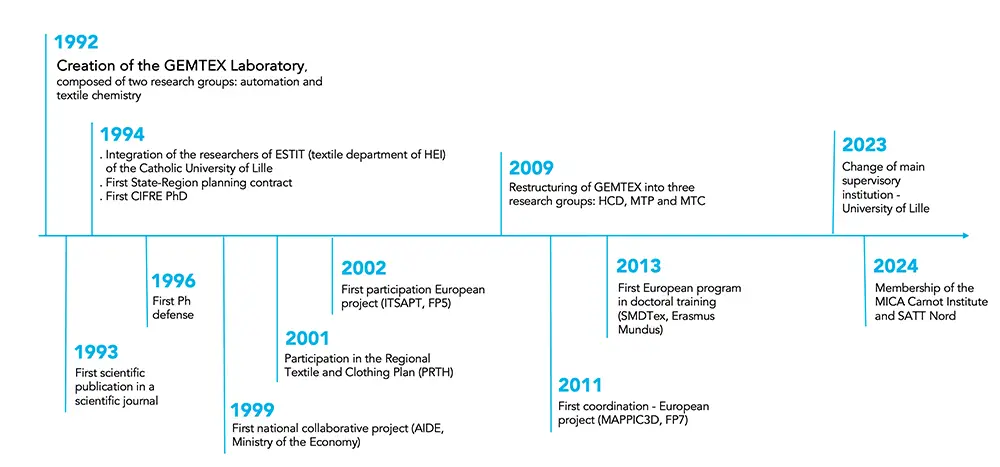
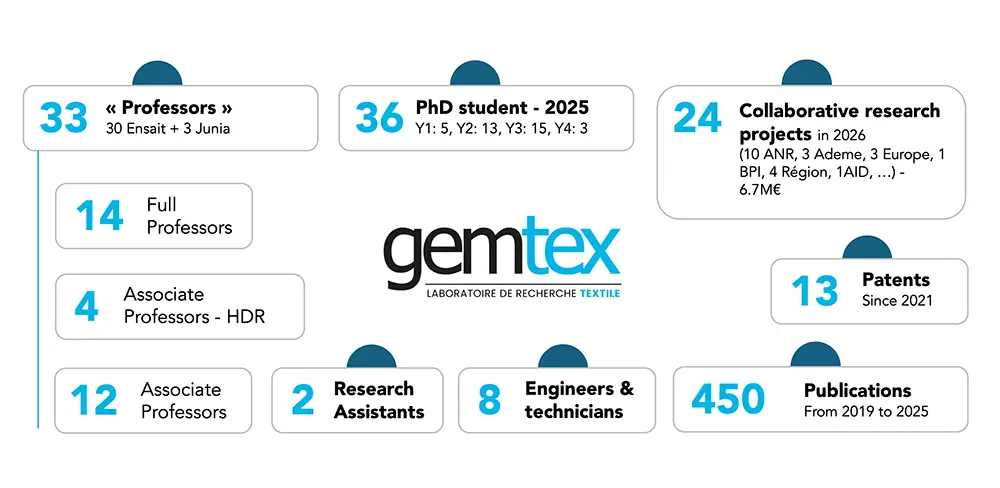
The GEMTEX research unit was established in November 1992 with the aim of conducting research leading to tangible and intangible innovations in the textile industry, drawing on the latest scientific and technological knowledge. Over the last 30 years, GEMTEX has gradually expanded, growing from a small group of five lecturers and researchers into a medium-sized research unit (32 lecturers and researchers and 37 PhD students, as of January 2026).
Since 1994, the unit has also welcomed lecturers and PhD students from JUNIA, the engineering school of the Catholic University of Lille. Since 2023, within the framework of the EPE, its primary supervisory body has been the University of Lille, and its associated supervisory body is ENSAIT. The École Nationale Supérieure des Arts et Industries Textiles (ENSAIT) is the largest centre in Europe for initial training at Master’s level (engineering degree) in the specialism of fibrous materials.
A MULTIDISCIPLINARY LABORATORY
The GEMTEX Laboratory contributes to the development of interdisciplinary research projects aimed not only at driving innovation in the textile, clothing and retail sectors through new sustainable and connected materials and digital tools, but also at designing innovative, high-value-added textile materials and products that help restore industrial sovereignty and contribute to the reindustrialisation of France across a wide range of application areas (clothing, transport, cosmetics, health, safety, sport, aeronautics, robotics, etc.).
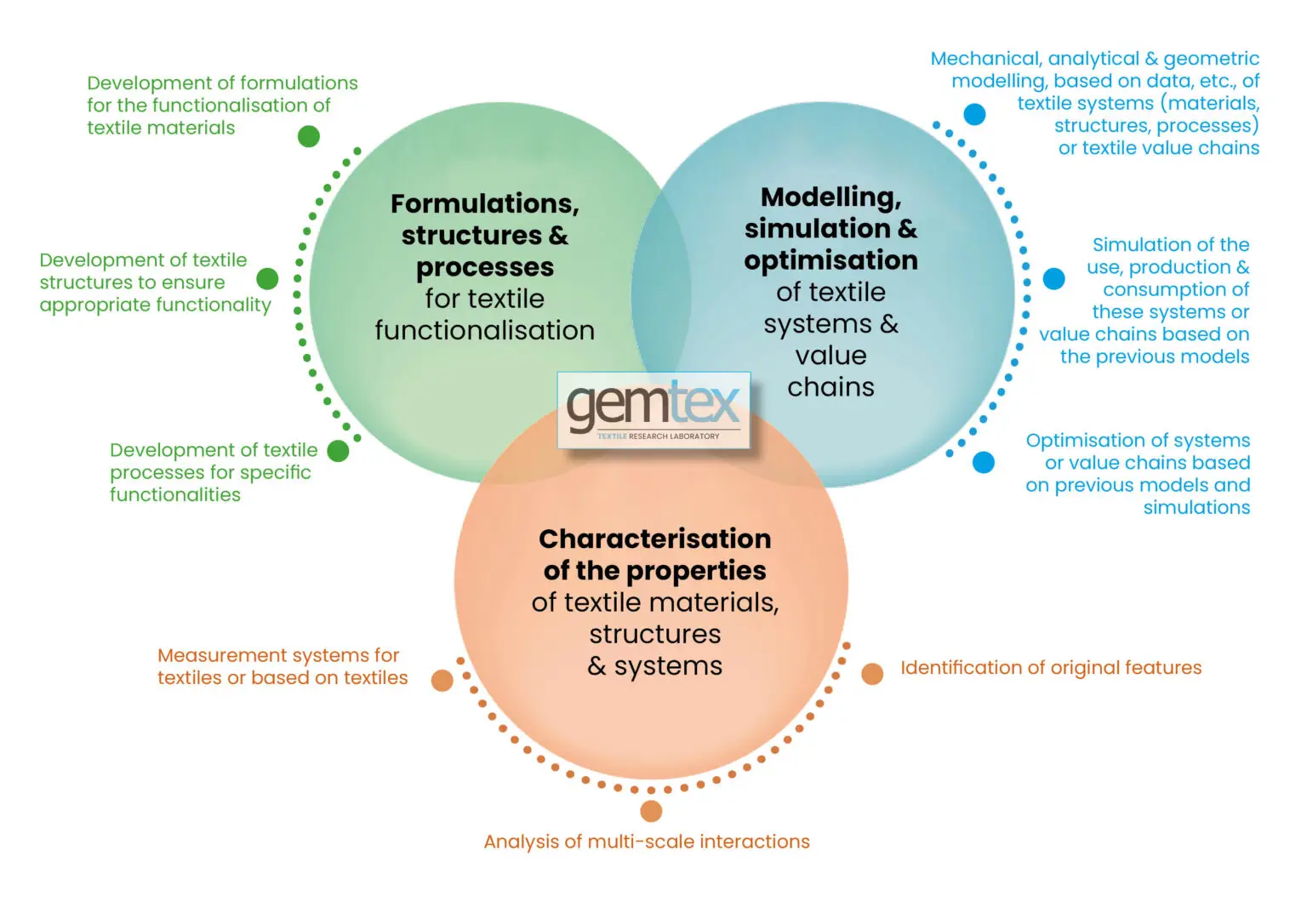
All activities are organised around three research areas, encompassing all the unit’s research projects and technology platforms, namely: (i) modelling, simulation and optimisation of systems and value chains in the textile sector, (ii) the physics of textile materials, structures and systems, and (iii) formulations, structures and processes for the functionalisation of textiles..
SOME KEY FIGURES
Two graduate schools
The Textile Engineering and Materials Unit (GEMTEX) is a ULR research group (No. 2461) based at the Ecole Nationale Supérieure des Arts et Industries Textiles (ENSAIT) in Roubaix. The Gemtex is primarily overseen by the University of Lille and ENSAIT.
The missions of the project mentoring committee, goals and strategy
NEWS
A new defense of doctoral thesis
05/10/26
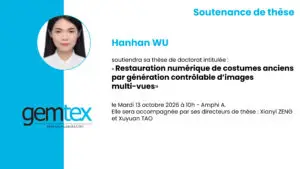
Hanhan WU will defend her doctoral thesis entitled: “Digital restoration of ancient costumes by using controllable multi-view image generation » on monday 12th of October 2026 at ENSAIT. She will be supported by her directors : Xianyi ZENG et Xuyuan TAO
A new defense of doctoral thesis
02/10/26
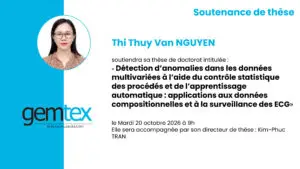
The Thuy Van NGUYEN will defend her doctoral thesis entitled: “Anomaly Detection for Multivariate Data Using Statistical Process Control and Machine Learning: Applications to Compositional Data and ECG Monitoring” on Thusday 20 october 2026. She will be supported by his supervisor: Kim Phuc TRAN.
A new defense of doctoral thesis
28/09/26
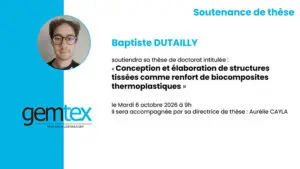
Baptiste DUTAILLY will defend his doctoral thesis entitled: “Design and development of woven structures as reinforcements for thermoplastic biocomposites” on Thusday 6 october 2026. He will be supported by his supervisor: Aurélie CAYLA.
A new defense of doctoral thesis
13/09/26
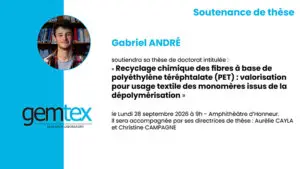
Gabriel ANDRÉ will defend his doctoral thesis entitled: “Chemical recycling of polyethylene terephthalate (PET)-based fibers: recovery of monomers from depolymerization for textile applications” on Monday 28 September 2026. He will be supported by his supervisors: Aurélie CAYLA & Christine CAMPAGNE.
Thesis offer
11/09/26
Sujet : « Etude et prédiction de la durabilité de textiles à usage professionnel » – Cette thèse CIFRE permettra d’étudier la durée de vie de linges plats au sein de l’entreprise Tissus Gisèle et du laboratoire GEMTEX (ULille, ENSAIT). Plus d’informations ici
Two new ATER (Temporary Teaching and Research Assistant)
11/09/26
Two ATER will be joining us throughout this new academic year. They are Timea Banfalvi, whose contract has been renewed, and Elaissi Arwa (new recruit). We wish them both a great start to the new academic year!
Two new nominations at Gemtex Laboratory
09/09/26
Congratulation to Cédric COCHRANE now professor and Quentin WATEL, now lecturer for Gemtex and Ensait
A new defense of doctoral thesis
08/09/26
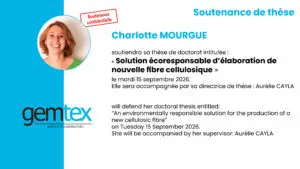
Charlotte MOURGUE will defend her doctoral thesis entitled: “An environmentally responsible solution for the production of a new cellulosic fibre” on Tuesday 15 September 2026. She will be supported by her supervisor: Aurélie CAYLA. The defense is confidential